CATS

Screen Shot 2020-01-05 at 18.38.19.png

image-1

This is not the worst film of the decade like some have said, it’s not even the worst film of 2019. Tom Hooper’s “CATS” is bizarre, largely unnecessary and in many instances simply poorly executed, but I would be lying if I said that there weren’t large stretches where I forgot that I was supposed to hate this film and enjoyed myself.

Having watched the film, I couldn’t get through my head how producers and executives gave the go ahead for this at all. The entire premise of CATS is completely unsuitable for the screen as there is simply no discernible narrative by which to grab an audience. In a nutshell, a gang of cats called the Jellicles present themselves every year to the head Jellicle to decide who will be chosen to go onto another life. The reason that CATS has worked so well on the West End is because of the music, the spectacle, the costumes, the set design, the choreography and because CATS is such a freaking institution in itself, it’s allowed to not conform to the typical narrative conventions of a film or even other stage musicals.

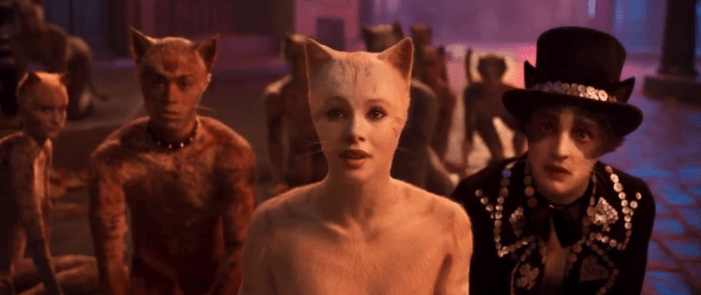
First things first, it was disappointing to see the unnecessary and shaky use of CGI in this film, which has been rightly panned for how inconsistent it is. The cast of the stage show at least had cat-like make up, these are human faces on furry bodies with cat ears and the effect is disconcerting and looks strangely amateurish and incomplete.

I’m not a fan of Tom Hooper as a director. I find his direction stilted, unimaginative and contrived, especially so in his 2012 adaptation of Les Miserables which I can remember watching and hating every moment. It’s strange that he keeps returning to musicals, especially since his style just isn’t compatible for the genre. He relies heavily on hand held cameras and for some reason likes to get right up into the grill of the singing figure, even in big set numbers with the entire ensemble. While this worked to a degree for Anne Hathaway’s Oscar winning three minutes in Les Mis, he uses the technique far too often and it becomes tiring very quickly. And by doing so, Hooper effectively removes two of the key appeals of CATS the stage show, those being the choreography and the company dance numbers. By jumping from close up to close up in such early songs as “The Invitation to the Jellicle Ball” and “The Rum Tum Tugger”, Andy Blankenbuehler’s choreography (of Hamilton fame) is made largely redundant.

It’s like this for the good first half of the film and it was killing me. I had actually resigned to the fact that I was going to loathe the entire experience until Old Deuteronamy makes an appearance and for some reason Hooper decides from then on in to bring the camera back and let the company do their thing, essentially allowing a sense of the theatre to return. From then on in, I relaxed and started to really enjoy the spectacle (the set design at times really is spectacular) and the iconic musical numbers themselves (“Skimbleshanks: The Railway Cat” was especially done well and I’ve been been humming “Mr. Mistoffelees” for two days now).

Performance wise, Francesca Hayward is the clear stand out as Victoria in an unexpectedly clever casting move. Hayward is the principal dancer for the Royal Ballet in Covent Garden and is delicate and innocent as Victoria the white cat. Rebel Wilson and James Cordon have been delegated to comedic relief and neither really do it justice, indeed Wilson is patently unfunny and irritating when on screen. Judi Dench of course holds gravitas as Old Deuteronomy but can’t hold a note at all and it was uncomfortable to see her warble and rasp through her lines. My mate who I saw the film with started laughing when Jennifer Hudson started singing “Memory”, (well “singing” is probably a strong term as she snots and sobs her way through the ballad, only really properly delivering in the final couple of lines).

This isn’t a great film. The direction is sloppy and inconsistent, a number of the performances were very average and the final product was in need of a serious re-edit. In saying that, it’s not the unmitigated disaster that I had been promised and even though it may have happened in spite of Tom Hooper’s misguided efforts, the magic and the charm of the stage show have managed to seep through.

By Jock Lehman.


Knives Out

Screen Shot 2019-12-15 at 19.43.26

This hasn’t been a strong year for films.

Somebody asked me the other day what my favourite flick of the year was and I really had to think; not because there were so many to choose from but because nothing really stood out to me. Having seen Rian Johnson’s “Knives Out” this week however, I think I may have found a strong contender. This is a witty, sharp, funny and fiercely entertaining homage to the “whodunit” mysteries of Agatha Christie and incorporates this style into the modern day with surprising finesse. This is definitely the most fun I’ve had in the cinema all year, and judging by the gasps and exclamations from the rest of the audience in my screening, I wasn’t the only one sitting on the edge of my seat.

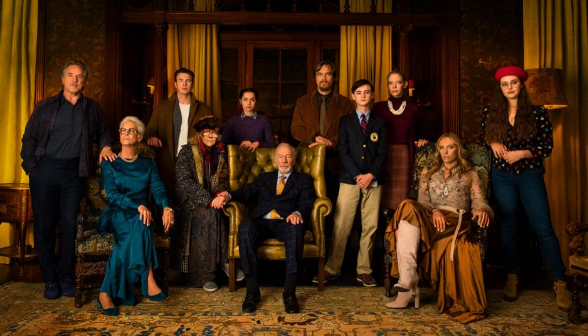
While the mystery genre is a popular one, there have been some absolute shockers in the past and “Knives Out” could have easily gone in the same direction. Assembling a stellar cast and whacking them in an austere murder house is nothing without a tight script, a strong build-up of suspense and a well-executed twist that takes the audience by surprise while also making us kick ourselves for not seeing it in the first place. The premise of Knives Out is as conventional as it comes, and I loved it for it; wealthy crime author Harlan Thrombey (Christopher Plummer), is found dead by his housekeeper the day after his 85th birthday party. Everybody in the family has a motive for murdering him, from his ambitious and stony eldest daughter Linda (Jamie Lee Curtis) to his spoiled playboy grandson Hugh (Chris Evans) and the only one to solve the mystery is of course renowned private detective Benoit Blanc (Daniel Craig with a delicious Savannah drawl), with the help of Harlan’s Hispanic nurse Marta (Ana de Armas).

It’s a ripper cast, and there’s always a danger in big ensembles that usually striking actors and actresses will become lost and somewhat redundant. Johnson has recognised this, and has given each prominent member of the cast at least one meaty scene in which they are the central focus and in which they can really stretch their acting chops (I was reminded of Ingrid Bergman winning a Best Supporting Actress Oscar for “Murder on the Orient Express” for what was essentially a five minute monologue). The performances were strong across the board, especially Toni Collete who plays Harlan’s daughter in law Joni, a sycophantic Instagram influencer and lifestyle guru who drips with false sincerity with every self righteous syllable. None of the performances are necessarily extraordinary, but I wasn’t expecting them to be and they certainly don’t need to be for the film itself to work as well as it does.

In order to contextualise the family and make it relevant to 21st century America, each member of the family represents the polarities in the current political and social climate. Some are blatantly Marxist “liberal snowflakes” while others are alt right neo-Nazis. What was clever though is that they’re all portrayed as assholes, so it’s not trying to justify either perspective. I was so glad to see a film not take sides in this sort of thing; they’re all suspects, all despicable and all equally capable of murder regardless of their political leanings.

The plotting and the inevitable twist is done well, perhaps no more so than any of the better Agatha Christie stories, but well enough. Some of the reveals I thought were a little bit too convenient and contrived, but for the most part I think hold up. For me the trick with these murder mysteries is whether, as an audience member, you are convinced that you could have put it together yourself once all the clues are revealed. There were definitely times here when I rolled my eyes at how silly some of it all was, but this is a very minor criticism. And maybe a degree of absurdity is all part of the fun.

That’s what I’ve taken away from this film; this was good old fashioned fun, flashy and extravagantly entertaining in a way which I hope will inspire more filmmakers to have a play with this style of film. Escapism in film is a wonderful thing if done well, and Knives Out has it in spades.

By Jock Lehman

Ford v Ferrari

Screen Shot 2019-12-05 at 14.52.10

img_5028-1

I loved movies like this as a kid.

“Ford v Ferrari” is pure, glossy entertainment, and unashamedly so. It’s far from revolutionary and is by no means perfect, but it’s a fast paced, thrilling, cheesy racing flick with goodies and baddies and an exciting lead up to a climactic final race. The heroes are quick witted, reckless, handsome and we as an audience can’t help but root for them all the way as they play by their own rules and give authority the finger all the way. The baddies are sleazy, stitched up, money hungry corporate drones in grey suits. And the cars are fast and loud and freaking cool.

“Ford v Ferrari” tells the true story of when Ford famously beat Ferrari at the 24 hour 1966 Le Mans race in France, subject to some poetic licence. Following Enzo Ferrari’s rejection of Ford’s offer to buy them out, Henry Ford II decides to take the advice of Ford Motor Company Vice President Lee Iacocca, invest in his own race car and defeat Ferrari at Le Mans and humiliate Enzo Ferrari. Iacocca hires owner of “Shelby America”  Carroll Shelby (Matt Damon), a racing driver who won Le Mans some years before, to manage the development of the racecar and the drivers. He enlists Ken Miles (Christian Bale), an unconventional and plucky British racer to compete at Le Mans who definitely doesn’t conform to the “Ford image” and the film follows the journey to Le Mans and the conflicts between Shelby and Ford Senior Vice President Leo Beebe (Josh Lucas) to get the car over the finish line.

The friendship between Shelby and Miles is a central theme of the film, and Damon and Bale have undeniable chemistry. Neither of the performances are Oscar worthy, but neither is the material they’re working with; both actors understand this and have fun with what they’re doing. The film reminds me of those 90s classics like “The Mighty Ducks” or “Cool Runnings”; through the medium of sport, we are taught about the value of friendship, family and how winning isn’t everything (although that’s easier to swallow if the heroes actually do win). There are plenty of textbook heartwarming and touching moments, especially with Miles and his son (Noah Jupe) as he seeks to bestow his love of racing onto his son.

There are no shortage of funny moments either though, notably a scene where Miles and Shelby get into a scrap in the middle of the street (not dissimilar to Colin Firth and Hugh Grant in Bridget Jones’ Diary) and Miles’ wife (Caitriona Balfe) brings out a deck chair and Coca Cola to watch. Caitriona Balfe as Mollie Miles is unexpectedly actually quite impressive; the perfunctory wife role in films like this are often thankless, but Balfe brings a real authenticity and grit to her performance and keeps up effortlessly with the powerhouse that is Christian Bale.

One thing I would have loved to have seen is Miles and Shelby properly get back at Leo Beebe before the end of the film, even if it was just them dumping a vat of something over his head and ruining his suit. In fact it was a little confusing how Henry Ford and Leo Beebe were portrayed; we’re supposed to be rooting for Ford to win, but Ford and Beebe are scheming scumbags. We’re supposed to be suspicious of the Italian Ferrari team, but they’ve never actually done anything wrong and in the commotion of one of the final scenes, Enzo Ferrari tips his hat to Miles for his race. It was a nice moment, but a movie like this should have just made it easy and made the goodies the goodies and the baddies the baddies.

I think that’s the thing; this should have been a D grade movie which went straight to DVD, but with this script, the cinematography the way it was and such a stellar cast, there’s a good chance that “Ford v Ferrari” could easily slot in with those feel good sports films of the 90s.

By Jock Lehman

Charlie’s Angels

Screen Shot 2019-11-25 at 21.37.12.png

This actually wasn’t the train wreck I was anticipating.

The all-female franchise reboots that have become popular of late haven’t exactly set the greatest precedent (here’s looking at you Ghostbusters), so I went into the latest “Charlie’s Angels” with low expectations. And don’t get me wrong, this film is nothing spectacular; the plot and villains are largely non-descript and the whole thing doesn’t come close to the fun and charm of the early 2000s installments with Cameron Diaz, Lucy Liu and Drew Barrymore. But there’s also plenty to enjoy here as well; the action is slick and well orchestrated, the Angels perform gravity defying karate and there are a couple of funny one liners. It’s a light, forgettable summer blockbuster, but it is disappointing that this didn’t breach that next level, and I think that’s due to a mediocre script and the lack of star power amongst the new Angels.

The story for this latest instalment is largely inconsequential; two Angels, Sabina (Kristen Stewart) and Jane (Ella Balinska) are assigned a project to recover a new energy device called Calisto, which could be deadly in the wrong hands. They’re teamed up with one of the scientists behind the Calisto technology, Elena (Naomi Scott), who luckily knows kung fu just as well as the others and headed by their newest Bosley (Elizabeth Banks), they set off to save the world.

Like I said, the plot is fine. There are probably one too many double crosses thrown in there and some confusing pacing choices, but overall the plot points are what I would have expected. What is strange is the characterisation of each of the Angels themselves. What was great about the two films from the early 2000s was that there was a definite sense of friendship and sisterhood that linked the Angels and that’s what is supposed to make them such a formidable crime fighting team. It was also a refreshing and fun take on the action genre, which is usually dominated by the angry, solitary man with a chip on his shoulder. The Angels in the earlier films had fun together, they bounced off each other well and you could tell that the actresses were enjoying themselves, and as a result, the audience does too.

This latest instalment doesn’t have any of that.

Each of the Angels are strangers when they meet, and though the film tries to force it towards the end, there is little chemistry between them. And what’s more, I can’t understand why the production studio wasted money on roping Patrick Stewart into what is a pretty generic and underwhelming supporting role and didn’t recruit some proper movie stars for the lead three Angels! I can understand some films needing an unknown for its lead, Wonder Woman being an example of this, but this is something where some star power I think would have really helped the film. There is nothing memorable or striking about the lead three actresses in this film (although they’re not given a great script to work with), with the potential exception of Kristen Stewart. I’m not the biggest fan of Stewart, but at least you could tell she was trying to have a bit of fun with the whole thing and inject a little personality into her character. Elizabeth Banks as the director was blatantly indulgent in casting herself as the new Bosley, and far from being the goofy comic relief from the first two, is now essentially a fourth Angel and the film suffers as a result.

The thing is, Charlies Angels is always supposed to be a little bit silly, a little bit unbelievable but most of all, a little bit fun. This latest instalment tries to do that, but is so intent on nailing the action and flaunting its feminist undertones that it forgets what made the original series and films appealing in the first place.

By Jock Lehman

Hustlers

Screen Shot 2019-11-10 at 20.50.18.png

img_5132

I actually really like Jennifer Lopez, but she’s so often under-utilised and she doesn’t exactly have the best string of films to her name so my expectations weren’t exactly high for this one. But I love it when I’m proven wrong. “Hustlers” is a genuinely well made, gritty, fast paced and gripping story with a ripper script and a career defining performance by Lopez. It’s one of those films that exceeds expectations by taking a well worn formula and taking the elements which usually get ignored and fleshing them out thoughtfully and meticulously.

Hustlers is the second film directed by Lorene Scafaria and tells the true story of a group of former strippers who, when business is sparse following the 2008 Wall Street crash, form a rink of con artists who seduce, drug and trick wealthy bankers into spending thousands at a high end club and waking up the next morning with no recollection of the night. The film is cleverly structured around a 2015 interview in New York Magazine with one of the ringleaders, Destiny (Constance Wu). Through a series of flashbacks, the film portrays how Destiny was befriended by Ramona Vega (Jennifer Lopez) and how their schemes escalated from small cons against scumbag men who had themselves lied and cheated their way to the top, to spiralling completely out of control and taking innocent people along the way.

There are certain similarities to “Wolf of Wall Street” in the basic plot points and themes of the film, notably in the undeniable allure in their extravagant and, for a short time, untouchable existence. What Hustlers actually does better than “Wolf” is that it creates a real dichotomy between the highs and the lows experienced by Vega and her crew. When things were good, things were very good indeed, with the women popping champagne and exchanging fur coats and Fendi bags in a lush 5th Avenue apartment. But when things were bad, these women have no education, no work experience and no prospects, with children and feeble grandparents to look after.

The film does well in not trying to justify the actions of the women too much or to try and paint them as victims seeking their just and righteous vengeance on the world, which could have happened very easily. Instead the women are portrayed as savvy, cut throat, opportunistic, and flawed. By not shying away from this, the audience is allowed to relax and buy the women as actual people, warts and all, not just two dimensional figures with no autonomy or capacity for corruption. There are moments when the women try to justify to each other what they’re doing, in the same way that we all sometimes seek to appease own own conscience when we know we’ve done something bad, but that conscience is easily quashed when nobody gets caught.

Performance wise, Lopez is the undeniable stand out. This is the grittiest and most complex character she’s played, and it was gratifying to see her properly stretch her acting chops. She plays the duplicitous nature of Vega’a character so well that you can barely notice when Vega is being deceitful or genuine; Vega knows how to manipulate and charm people for her own gain, and Lopez plays her in a way that even as an audience member I felt myself being duped.

There are certain aspects of the film which could have used a touch up; Constance Wu as Destiny probably wasn’t the best casting choice, she was by far the most predictable and unenlightened performance, but maybe that was intentionally done so that she’d serve as a foil against Lopez. I also thought that Ramona and Destiny’s initial meeting was a little too convenient and rushed.

In saying that though, the script is largely sensational; there’s a particular scene in which Ramona tells a story to her girlfriends after Christmas dinner, it didn’t serve to further the plot and the film probably would have worked just fine without it but it showed the relationship and dynamic between the women so organically that it didn’t matter. It’s something that Hustlers does well where so many other Hollywood films stumble; it’s so much more effective to establish relationships through the ordinary interactions and well written dialogue, allowing the audience to figure it out for themselves rather than treating them like idiots and blatantly spelling it out for them.

Hustlers is an electrifying twist on the mobster crime thriller with a strong leading cast and masterful direction. This film could easily have been another lukewarm J-Lo flick, but more than anything else, Hustlers is a reminder on how powerful a relatively simple story can be when all the elements are executed with proper skill and care.

By Jock Lehman


Judy

Screen Shot 2019-10-20 at 17.08.45.png

img_5028-1.jpg

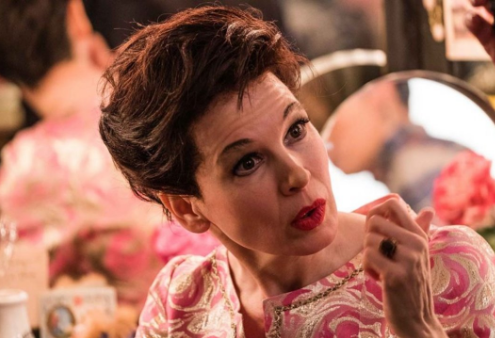
I was really happy to see Renee Zellweger back on the big screen. I think she’s a sensational comic actress, but I also think she’s seriously underrated for her dramatic chops. I was excited to hear she’d be playing Judy Garland, but portraying such an iconic figure is one of those risky roles which can go one of two ways; I knew going in that she’d either be up for an Oscar or that she’d be berated right out of Hollywood.

Luckily, Zellweger is phenomenal, which is a good thing since the film would be nothing without her. As far as story goes, “Judy” follows the stock standard biopic manual almost to a tee and in some ways I think simplified aspects of Judy Garland’s extraordinarily complex life. But I actually didn’t mind so much; this film was a vehicle for an unbelievable performance, and whenever Zellweger is on screen you can’t help but be enthralled by what is a true embodiment of Garland. Zellweger goes beyond just an impression, the accent, her performance style and the smallest mannerisms are so deeply entrenched in her portrayal that you forget that you are watching a depiction at all and are able to genuinely believe that the figure on screen really is the legend herself.

“Judy” depicts the last few months of Garland’s life as she tries to relaunch her stage career in London. The film opens with Garland at age 46, addicted to prescription medication and alcohol, and being evicted from her hotel suite for nonpayment of her account. Unable to provide a proper home for her two children, Garland moves to London to perform for a string of sellout concerts at the famous “Talk of the Town” where the Brits are still in love with her.

The director knows that a lot of Judy Garland fans will be wanting to see the great numbers which made her an icon and the film doesn’t shy away from that. It’s difficult enough for an actor to capture the essence of an individual just in their speech and decorum, but Zellweger manages to actually sing and perform with the same distinct style as the great Judy Garland and makes it look so effortless! After her first performance of “Come Rain or Come Shine”, the scene cuts to Garland sitting slumped over and drunk in her dressing room; the film highlights beautifully the difference between the person of Judy Garland and the mask she wore as a star.

The film plays out more or less how you’d expect it to, but there was one ingenious scene which I didn’t anticipate; after one concert, Garland meets two gay fans who had been waiting for her at the back of the stage door. They congratulate her, tell her that they’re huge fans and she asks them if they want to go for dinner so they get drunk and sing show tunes back at their place over a plate of scrambled eggs. This probably (almost definitely) didn’t happen in real life, but it was such a lovely little moment that showed Garland’s yearning for normality.

Judy Garland had an undeniably tragic life, and there’s no shortage of emphasis for this. Throughout the film there are a series of flashbacks to a young Judy Garland at the height of her career, being sleep deprived and force fed amphetamines to keep up with the gruelling rehearsals and press commitments and then other drugs to bring her down again. The pervy and repulsive head of MGM Louis B. Mayer calls her fat and says that the only reason she’s here and not any of the many prettier and more talented girls out there is because of her voice. I thought these flashbacks were a little jarring and unnecessary; it’s pretty obvious from context that Garland was abused by MGM as a young actress and any time when Zellweger isn’t on screen draws attention to the comparatively lacking nature of the rest of the film. The portrayal of Garland’s marriage to Mickey Deans is especially shallow and reductive, and has been wedged in without any proper sense of execution or thought.

One thing I didn’t expect was for the film to be as funny as it was; I think it’s a sad thing that the world’s memories of Garland are shaped in many ways by her last moments of decline. Her life was undeniably tragic, but I liked that Zellweger was able to bring some humour to her role and remind the audience that Judy Garland was a true Hollywood star, but also a person who was a mother, a quick wit, warm, funny and ultimately human.

By Jock Lehman


Joker

Screen Shot 2019-10-08 at 20.31.34
image-3

This was such an unexpected and rattling disappointment.

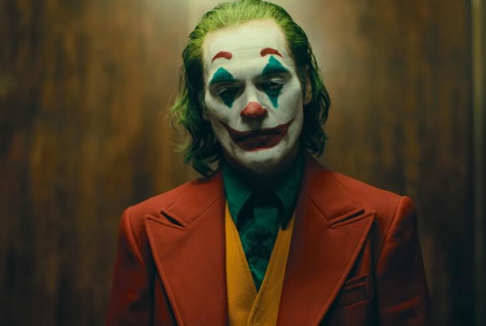
I hated this film; I hated that it was so dishonest, manipulative and reckless in the depiction of some truly heinous and brutal themes, I hated that it was so convinced of its own artistry that it didn’t bother with an interesting or unique story, I hated that the  almost universally adored performance by Joaquin Phoenix was completely without subtlety or nuance, I hated that the film completely misrepresented the character of the Joker, but most of all, I hated that the Joker himself, one of the most famous and sinfully evil villains in film and literature, was portrayed as mentally ill for no discernible reason and the heinous acts that he commits nothing more than a manifestation of his condition.

Joaquin Phoenix plays Arthur Fleck, a mistreated and emaciated party clown with a neurological condition where he laughs uncontrollably at unexpected moments and visits his social worker weekly to top up his multitude of different medications. He lives with his elderly mother Penny (Frances Conroy) in Gotham city, which is rife with poverty, crime and corruption, and after getting beaten up by some street thugs, Arthur is given a gun to protect himself. After getting attacked by some frat boy financiers from the evil Wayne Industries, Fleck shoots them, becomes an overnight symbol for the poor and oppressed and the rest of the film is Fleck finding a sense of identity and purpose in murder and claiming revenge against a world which has abandoned him.

Phoenix, who is an admirable actor in his own right, has fallen right into the trap of portraying someone with a mental illness and thinking that its a free pass to acting as  insane as possible without any subtlety or actually developing the character. There is no arc to Arthur throughout the film, he is as one noted and heavy handed in the first five minutes as he is in the last frame and its a shame because with some proper direction he could have done something extraordinary. Phoenix lost a ridiculous amount of weight for this film, as evidenced by the countless scenes in which Fleck is seen shirtless for literally no reason, but a physical transformation is nothing without a consistent and polished performance. Each scene seems like an individual audition piece rather than a coherent understanding of the actual character and the desperation to convey something to rival Heath Ledger is palpable. It doesn’t help that the script sounds like it was written by a film student and treats the audience like complete idiots with a paint by numbers plot, and rams clunky symbolism and unashamedly stupid lines like “I used to think that my life was a tragedy, but now I realise, it’s a f**king comedy” down our throats. Admittedly the cinematography at times is quite well done and the score is quite moving at times, but it wasn’t nearly enough to distract me from what really was such an amateur production.

It was so infuriating watching the smugness in which director Todd Phillips shot every frame; it’s obvious that he thinks he’s the next Martin Scorcese or Thomas Christian Anderson but he doesn’t even come close. Phillips is one of the filmmakers who believes that if they depict gratuitous violence, mental illness or suicide then they will be considered revolutionary, edgy and artistic for having the courage to talk about what other filmmakers are too afraid to. It’s a childish, lazy and self righteous approach, and “Joker” is dripping it. Fleck has a mental illness, but it’s never explained what is is he has or even bothers to properly explore how it affects him, instead he’s just constantly referred to as “mentally ill”. What was the most maddening thing was that there was literally no reason for him to have been depicted as mentally ill at all! The Joker is a villain; he’s evil and that’s just part of his character, and what Heath Ledger’s Joker nailed in “The Dark Knight” was that there was no logic to his wickedness, he just relished in chaos and “seeing the world burn”. He doesn’t want Batman to die because he’s is more about causing mayhem than actually working towards an end goal, money, or for such mediocre pursuits as revenge. Anarchy is what defines Ledger’s Joker, mental illness is what defined Phoenix’s.

I was diagnosed with Depression in 2013, and still take medication for it today. I don’t have a problem with the portrayal of mental illness on screen, I don’t have a problem with bad people being portrayed as having a mental illness. What I did have a problem with was the Joker being depicted as mentally ill when there was no necessity for it to be included in the plot at all and when all the moments of victory or clarity for the Joker are when he acts upon the destructive nature of this undisclosed mental illness. The sole purpose of the Joker being written as mentally ill in this film was so that Todd Phillips could sell the film as something provocative and to stoke his own artistic ego. It’s pure exploitation and when the final frame of Fleck dancing like a rocker faded away, I felt palpably angry.

By Jock Lehman 

Ad Astra

I was interested seeing some of the responses to James Gray’s ” Ad Astra”, where reviewers were throwing around phrases like “masterpiece”, “dazzling”, “hypnotic and philosophical space epic” with “(Brad) Pitt delivering an Oscar worthy performance”.

For me, this is pushing it a bit.

“Ad Astra” is actually pretty entertaining; it’s an action packed sci-fi which, had it been made in the 1980s, would have starred Arnie Schwarzenegger and run alongside such classics as “The 6th Day” and “Total Recall”.

This is a solid piece of fun which will easily find itself in the 8:30 Saturday night movie rotations on free to air tv, and I enjoyed it, but it’s far from a masterpiece, and what’s more, there’s absolutely nothing wrong with that.

“Ad Astra” is set in the near future, where space travel has been commercialised to the extent that anybody can fly to the moon for a vacation and purchase a blanket on the trip for $125. Major Roy McBride (Brad Pitt) has been recruited to investigate a string of strange power surges which have threatened all life in the solar system and is sent on a mission to Mars to investigate. The thing is, Roy is the son of Major Clifford McBride (Tommy Lee Jones) who went missing some 16 years earlier, and Roy soon discovers that his father may be alive after all and the one behind the power surges. And so Roy sets off on a journey to save the solar system, find his lost father and find himself in the process.

If this sounds cheesy at all, that’s because it undeniably is. The premise is pretty stock standard for a sci-fi, and in a way I did enjoy the fact that the script is so unapologetically sappy and without subtlety, because it fits in nicely with the Arnie-esque actions from the 80s, although I don’t think this was on purpose. If the director was in fact aiming for something profound and meaningful, he missed the mark completely. The entire film is punctured by unnecessary and clunky narration from Pitt, featuring such tear jerkers as “I don’t know if I hope to find him or finally be free of him”. There’s never a moment where the audience has to think for itself, because any subtle glance or expression is accompanied by a wanky and sombre description of it. Brad Pitt himself is a pretty decent actor I think, and he’s certainly not bad in this, but like I said before, this film would have worked just as well with Arnie.

The film itself isn’t actually driven by the fact that it’s set in space; this could have been set in the jungle or the desert and would have worked just fine. It does allow for some pretty impressive cinematography and cool set pieces though, and I appreciated that they didn’t try and explain the science behind space travel; there are Starbucks’ on the moon, the physics doesn’t really interest me anymore.

Where the film does well is when it allows for the fun of the sci fi genre to run its own course. It’s fun seeing what the moon looks like with airports and hotels, and when space pirates started shooting at Brad Pitt and his crew from their dune buggies, I could hear ten year old Jocko bouncing around in my head saying that he wanted to be a space pirate too. I think they could have gone a bit further with all of this though; the pensive and contemplative second half of the film, (especially Pitt’s scenes with Tommy Lee Jones) aren’t handled terribly well and feel somewhat anticlimactic considering we’d just travelled across the entire galaxy to get there.

The themes of identity and finding one’s path through life have certainly produced powerful films in the past, but Ad Astra just isn’t one of them. This is a fun sci-fi which could have been a whole lot better if it had simply embraced that and not tried to make itself into something that it just wasn’t.

By Jock Lehman


It: Chapter Two

Screen Shot 2019-09-11 at 21.45.55

I really enjoyed the 2017’s “It”. I thought it was fresh and clever and scary in an unexpected way but also had a sense of Goonies-esque fun about the whole thing with a young cast of talented actors who brought a genuine and organic chemistry to the “Losers”. “It: Chapter 2” has some impressive moments in its unnecessarily long two hour and fifty minute run time, but unfortunately it doesn’t come close to the first instalment. A lot of what was dynamic and interesting in the first film is somehow stale and unimpressive in the second, there is a distinct lack of a cohesive story but to me the biggest failing of “It: Chapter 2” is its underutilisation of Pennywise the clown.

“It: Chapter Two” begins twenty seven years after the events of the first, each member of the Loser gang has grown up with varying degrees of success. Unexplained murders have started up again and Mike contacts the rest of the crew for them to make good on their oath twenty seven years earlier to kill Pennywise if he ever came back. The gang gets back together, and after catching up on old times, set off to find and kill Pennywise once and for all. The grown up Losers have actually been matched up to their younger counterparts pretty well, particularly James Ransone as Eddie and Bill Hader as Richie. I  thought it was a sensible idea to have the flashbacks of the kids back in the 80s, because the grown up actors just don’t have the chemistry that the kids do and it works as a reminder of the dynamic of the original group.

The screenplay was probably limited to some extent because of what happens in the book, but I was surprised but how unimaginative and pedestrian the story was in this film. I liked each of the Losers going off to confront Pennywise and their fears individually, particularly a scene in which Beverly is confronted by a possessed old lady who lives in her old apartment, but that is only about twenty minutes and is the only real part where the film evokes some of the suspense and polish of the first film. The fact that a significant portion of the film is the Losers returning to the creepy old mansion and basically playing out exactly what happened in the first film was disappointing and underwhelming. It was the same old scares and the same old tricks and the same old struggle to overcome their fears to defeat Pennywise, except they’re all grown up this time.

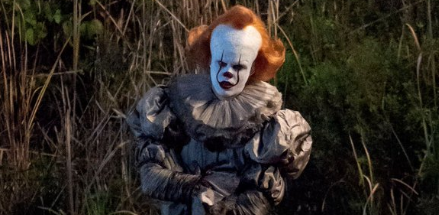
They had defeated the clown once already, so from the get go Pennywise just isn’t as intimidating and instead of enhancing what made him scary in the first one, the filmmakers for some reason made him more comical and ridiculous so that there are no stakes in the expedition at all. There is one sensational scene where Pennywise lures a little girl away from her family under the bleachers of a football game, similarly to Georgie in the first film. That was what makes Pennywise terrifying; when he was smiling and talking sweetly and you’re not sure at what moment he’s going to flip the switch, not by transforming him into a giant or a spider. Clowns are scary enough, and Bill Skarsgard is so impressive as Pennywise that he should have been left alone to do his thing without all that unnecessary CGI.

Then again there’s all the bizarre subplots that feel wedged in and add nothing to the story. Pennywise doesn’t need to be explained; he’s a scary clown that eats kids and we as an audience don’t need an origin story to work that out because the mystery is all part of the fun. All the Aztec elements and the ritual to kill the clown out of place and unnecessary, especially with a run time as long as this one.

While there are certain parts of this film which are done well and the performances aren’t bad, the whole thing ultimately felt unnecessary and like a wasted opportunity. This is especially disappointing when the property itself and Pennywise as a villain holds so much potential that with the right director and a decent screenplay, “It: Chapter Two” could have been something impressive.

By Jock Lehman.

The Kitchen

Screen Shot 2019-09-02 at 20.28.32.png

img_5478

Andrea Berloff’s “The Kitchen” is just about as bad a film you can get, and breaches the point of being uncomfortable and into being so horrendous that it’s actually funny. This was staggeringly incompetent in every possible sense; from the blatantly stupid script to the clunky performances and the story itself which charges along for an hour and 40 minutes without a hint of originality or self awareness.

It’s strange because Berloff has worked on some fairly successful films as a writer, most notably “Straight Outta Compton” (which was nominated for an Oscar for best original screenplay) and “World Trade Centre”. Berloff directed “The Kitchen” as well as wrote it, so it could well have been that she simply isn’t much of a director, were it not for the script itself which is potentially the worst aspect of the film.

I’ve spoken before about films which champion female empowerment and how there are some which have done it beautifully through character development and good storytelling. Then again there are others which throw in feminist catch phrases throughout and, almost arrogantly, assume that that’s enough. The Kitchen unfortunately falls into the latter category, with such gems as “All these men working these streets, and not a solid set of balls anywhere” and “All my life I’ve had men holding me down, now we run this neighbourhood”.

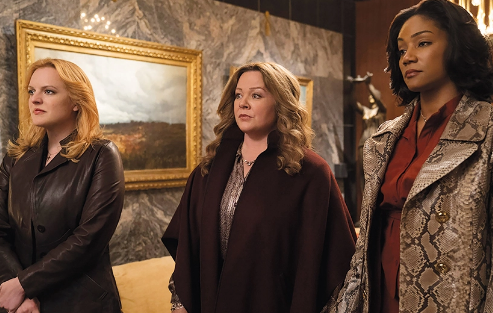
“The Kitchen” is based off a comic book series of the same name and tells the story of three women in the 1970s whose husbands are members of the Irish mob and take over operations when their husbands are sent to jail. The whole film is basically these three women (Melissa McCarthy, Tiffany Haddish and Elisabeth Moss) as they take over control of crime operations for New York’s Hell’s Kitchen, delivering sassy one liners and then strutting away to songs like “Ooh barracuda” with occasional moments of unnecessary and blatant violence and gore.

The frustrating thing is that there is potential here for something quite cool; an almost identical premise worked incredibly well for last year’s “Widows”, which was well acted, had an engaging and intelligent script and delivered on everything you could want from a gangster flick.

It’s actually a fun premise and could have been something really interesting, perhaps not up there with Scorsese’s mobster flicks but certainly something more than this crock. Melissa McCarthey honestly should know better; it’s obvious that she’s trying to break out of the slapstick routine that she landed in after “Bridesmaids”, and her turn in last year’s “Can You Ever Forgive Me” was commendable.

It’s undeniable that McCarthy is better than the material she had to work with, and it’s obvious that she’s trying to make it work. The only reason I’m giving this movie half a star at all is because of some moments towards the end where she actually managed to rise above the dialogue and deliver somewhat of an emotional response.

Elisabeth Moss is fine I suppose, but dammit somebody needs to stop Tiffany Haddish now. She can’t act, is pointedly irritating and is absurdly miscast in this film. The three leads have little chemistry, and their interactions feel more like disjointed audition pieces than actual conversations.

I was the only person in the cinema for this showing of “The Kitchen”, and within three minutes it was obvious why. Somewhere in this mess was real potential, but as it stands now, is in the running for the worst film of the year.

By Jock Lehman