King of Thieves

image-3

I’ve been trying lately to avoid reading reviews or even sometimes seeing the trailers for new movies before I go and see them, mainly so that I’m not influenced too heavily when I’m writing my own reviews. For “King if Thieves”, I knew that it started Michael Caine, Jim Broadbent and a few other older English actors and that it involved a heist of some kind. I expected it to be a bit of fun, a good popcorn movie and an easy gig for the old fellas. Nothing overly ambitious but perfectly enjoyable. This was the worst movie I’ve seen in ages. As the running time crept towards two hours, I seriously considered leaving the cinema.

How could they have messed this up so badly?! It would have been such an easy movie to get right; use the model from the Oceans franchise, substitute some jokes in about bad hips and prostates and let the cast do the rest. Instead, King of Thieves was boring, irritating, lazy and I cringed watching the old blokes trying to do their best with some seriously stilted and contrived dialogue I’ve ever heard.

The premise for the film is based on a true story and actually a pretty exciting one; a group of retired burglars pull of a £300 million heist of a London jewellery store in 2015. The elements are all there: a jewel heist and a bunch of funny cockney old fellas, it should have just fallen into place. It didn’t.

Firstly, it is never explained how the old blokes knew each other or gave any indication of the robberies they had pulled of in the past. The characterisation of each of the members of the gang is so inconsistent and weak that by the end I was still unsure who was who. How this film has taken some of the strongest British actors and turned them into interchangeable and bland blobs is beyond me.

There’s no real reason or motivation behind the actual heist at all, nobody really takes any convincing and there’s never any sense of urgency or any real stakes behind the operation at all. So as audience member I didn’t care whether they succeed or not because it didn’t seem that they did either. Which would have been fine if the heist itself had been fun and engaging! It’s not. It’s actually somehow one of the dullest part of the whole film, and includes a five minute montage of bank security boxes being broken open with crowbars.

Michael Caine’s character, initially the leader, decides to back out half way through for literally no reason at all. Then all of a sudden the other old men are assholes for again, literally no reason at all. These poor bastards, I genuinely felt sorry for all of them for having to do this. There’s no thought or creativity in any of the dialogue, the screenwriter instead relying on funny accents and lots of swearing to score cheap laughs. I realise that some of this is probably giving away plot points, but this whole thing was such a crock that I’d rather say it now and spare at least one person the price of a ticket.

When the film finished, I was palpably angry. You just don’t take an actor with a legacy like Michael Caine and screw him over like this. The whole cast and the source material deserved far better.

By Jock Lehman

Greta

I get the feeling with Neil Jordan’s “Greta” that the writers came up with the ending first, were so stoked on themselves and didn’t bother to put any thought into the rest of the movie. To be fair, the ending is a beauty, and the movie is worth watching purely for that. This type of horror has been well exercised in Hollywood; a seemingly sweet and benign character turns out to be psychotic and holds the protagonist captive. In this instance, the sweet psychopath is middle aged French lady Greta (Isabelle Huppert), who is somewhat scary as the film progresses but isn’t likeable enough to begin with for this to pack much of a punch. Also she looks and sounds just like Helen Mirren and that was distracting too. The victim is wide eyed Frances (Chloe Grace Moretz) who has lost her mother and takes pity on the lonely Greta when she returns her lost purse and they strike up a friendship. Admittedly, the script is schmultzy and annoying, but Moretz in my mind isn’t a strong actress so that certainly didn’t help either.

“Greta” instantly reminded of “Misery” starring Cathy Bates, which scared the shit out of me. Throughout the movie kept thinking about how much Misery worked, and how much this one didn’t. Ultimately, I think that the reason Misery is effective was that it was contained within the one little house, and because of that the rules of normal society didn’t apply. That’s why Misery is so terrifying, because it could actually and legitimately happen. The captive couldn’t call the police because his legs are broken and his captive has cut the phone line and nobody in the outside world knows where he is. So he has to come up with a way to outsmart his captor, and you’re rooting for him all the way. The problem with “Greta” is that the vast majority of the film takes place in the real world, with all the tools and services available to stop this sort of thing from happening.

By the time that Greta has actually arrived at the restaurant where Frances works and throws over a table in a crazed rant and the police still do nothing to help her, the movie loses any credibility or plausibility because the audience could no longer possibly picture this ever happening. There are a couple of moments where tension is handled well, but these are hidden by how ultimately drab, dull and unimaginative the rest of the movie is. Until the last 5 minutes, when I was completely blindsided by a genuinely good twist. I had resigned myself to the film being unoriginal, and it was a real thrill when it surprised me the way it did. That’s why I’m giving the movie two stars, purely for the ending. Is that enough to redeem the rest of the movie? Probably not, but they could have just let it play out as the audience would have expected, and they didn’t.

Good on them for that at least.

By Jock Lehman

Stan & Ollie

I think there are certain movies where the experience is heightened by who you watch them with. I remember 2016’s “Lion” because it was a story largely about the bond between mothers and sons, and I saw it with my Mum at the cinemas having come home from a year overseas the week before. I saw Jon S. Baird’s “Stan & Ollie” yesterday with my buddy Dan, and I’m so glad I did because this movie is one of the best I’ve ever seen about the power of friendship.

I absolutely loved this movie. It tells the story of Laurel & Hardy’s final tour around the UK in 1953 as an attempt to reignite their dwindling fame that had been declining since their peak in the late 1930s. This I think is the hidden cruelty of being in the entertainment industry; it doesn’t care about those they leave behind. Steve Coogen as Stan Laurel is the stand out of the film, embodying Laurel’s fear of obscurity and being forgotten beautifully. Coogen has a particularly expressive face and this serves him well in portraying the dichotomy between the geniality of the bumbling Laurel on stage and the struggle to maintain his dignity as Stan in the real world every time it reminds him that perhaps he’s not wanted anymore. One particularly poignant scene is one in which Laurel is waiting in a reception to see a film producer and performs some of his iconic routine for the receptionist who looks back unimpressed and calls ahead that a Mr “Lauren” had arrived.

Critics have been praising John C. Reilly for his performance as Oliver Hardy, and justifiably so. Reilly is likeable and sympathetic in his portrayal of a flawed man, and he particularly shines in the scenes where they draft new material together. The chemistry between Reilly and Coogen is undeniable, and their reenactments of the classic Laurel and Hardy routines is flawless. Shirley Henderson and Nina Arianda play Lucille Hardy and Ida Laurel respectively, and the script allows for their characters to be fully fledged and interesting characters in their own right, which often doesn’t happen for the wives and husbands of protagonists in Hollywood films.

There is a particular scene in which the duo finally address the underlying tension throughout the film; that Hardy sixteen years before had undertaken a movie with another actor following a dispute over their contract. The scene escalates so organically that I was sitting on the edge of my seat as they both exposed years of unaddressed resentment; each know the deepest insecurities of the other and know how to cause hurt in places and in ways that even their wives couldn’t.

“I loved us.”

“You loved Laurel and Hardy, but you never loved me.”

The closing scenes of the film are truly touching, as they both resign to the fact that their friendship has gone beyond mere circumstance and that one simply don’t work without the other. When in their final performance Hardy opts to close with their iconic dance number despite his health complications, I bawled like a freaking baby. There are times when maybe the script could have been tightened up a little, but overall, this was simply a happy experience, and I was stoked to have a mate there with me.

By Jock Lehman

The Mule

I like Clint Eastwood. Even now at 88 years you can still see how much of a bad ass the guy is purely from the expression in his face. Even when Mexican cartel thugs are threatening him with guns and patronisingly calling him “Papi” throughout The Mule, something about it seems strange because it is hard to believe that anybody could look into those eyes and not crumple.

I was disappointed with this movie. The premise is something that has merit; a cantankerous old horticulturalist becomes a drug mule for the cartel. The problem is, the film can’t decide either way as to whether they want to play it as a fish out of water, comedic piece or a gritty, Scarface-esque thriller. The end result is something in the middle, not enough either way to call it a success. Even if the script and direction were average, if the performances had been knock outs then the whole package might have been redeemed. They’re not though. The film drastically underutilises the talent in this cast; Eastwood is surly and mean eyed just like Eastwood always is and Bradley Cooper’s character, Special Agent Bates is so underdeveloped that it seems a waste to have Cooper in the role when any cast member from NCIS could have done the exact same thing.

More than anything else, the film just seemed lazy to me and is filled with painfully convenient plot devices. Earl Stone (Eastwood) somehow doesn’t realise that he’s trafficking cocaine for until his third trip despite the fact that each time he’s picked up his delivery from four tattooed, angry Mexican men with guns. It’s thrown in there that Earl was a Korean war veteran for no discernible reason at all; it doesn’t bring anything to the character other than to serve the image of Eastwood as a tough old man. His family all hate him because he has always chosen career over relationships, yet he’s so broke that he has to continue on as a drug mule because otherwise the county will take his house. The scenes with his family are perfunctory and forced, even reducing screen legend Dianne Weist to a cardboard cutout of a character who screams at Earl for not being a good husband or father.

Ultimately though, all that could have been forgivable if the film had just provided some cool moments that Clint Eastwood movies usually do so well! I was waiting for a shoot out scene with the cartels that never came, there was little or no tension created throughout the film and there is no exploration at all for why he has become the bitter old man he is other than a weird dialogue between him and his ex wife where he says that he always loved flowers because they were unique and deserving of his love. There are some funny moments where Earl interacts with lesbians and black people, showing the disparity between him and a world he just doesn’t understand anymore, but even those weren’t as satisfying as they potentially could have been. I think unsatisfying is probably the best way to describe The Mule; it had all the makings of something poignant and gripping, but never really allows itself to be either.

By Jock Lehman

On the Basis of Sex

In my previous review for Green Book I spoke about movie tropes that annoyed me, one of them being “the brave lawyer changing the outcome of a court case with impassioned but inherently stupid emotional monologues that no reasonable judge would allow”. Within the first five minutes of On the Basis of Sex, I was sure that later on there would be a moment where exactly that happened. The opening scenes were so stupidly bad I was already preparing for giving the film half or one star. Notably, the opening sequence of Ginsburg walking to her first day at Harvard as the only woman in a sea of suited men is almost identical to Elle Woods in Legally Blonde 2: Red White and Blonde, walking up the stairs of Congress in pink. As the film progressed however, while it perhaps didn’t live up to the potential of its phenomenal source material, it certainly wasn’t the train wreck I was anticipating.

On the Basis of Sex tells the true story of of Supreme Court Justice Ruth Bader Ginsburg from her initial admission to Harvard up to the historic win of Moritz v Commissioner of Internal Revenue in 1975. Felicity Jones as Ginsburg is what stops the first half hour of this film from becoming painfully simplistic and unbearable. The portrayal of Ginsburg’s time at Harvard and the difficulty she faced in finding a job as a lawyer is handled well enough, but where the film struggles is in depicting her relationship with her husband and daughter. The dialogue in these scenes is cringeworthy to the point of being laughable, and feels like sitcom-esque filler for the rest of the film. I’m sure that Ginsburg’s relationship with her family was an important part of her life, but as a viewer, I just didn’t care. The film spends a good chunk of time outlining the frosty relationship between Ginsburg and her daughter, but without any real depth. Marty Ginsburg’s testicular cancer is likewise handled so bizarrely that I thought I must have missed something or dozed off; the film literally has ten minutes of him being sick and then skips three years and he’s recovered and it’s never mentioned again.

Where the film redeems itself is when Ginsburg takes on the Moritz case as a means of setting the precedent for reversing US laws that allow for discrimination based on gender. The dialogue between Ginsburg and Mel Wulf (Justin Theroux) is quick and witty, and the final rebuttal provided by Ginsburg in court feels like something that would actually win a court case. In this sense the film is handled beautifully, Ginsburg didn’t win the case because she was a woman, she won because she was the better lawyer. If the film had focussed more on what actually made Ginsburg remarkable and the trailblazer that she undeniably was rather than wasting time on the superfluous family stuff, it would have moved closer to something extraordinary. Although, as the film closes on the real life Ruth Bader Ginsburg walking up the steps to the Supreme Court building in Washington, I got genuine and awe inspired chills.

By Jock Lehman.

Green Book

There are certain well known tropes in Hollywood films which screenwriters seem to love and will go out of their way to slide into the script. Some of the more irritating for me include the stitched up parent who eventually comes round to their teenager’s decision to abandon med or law school to follow their passion, two characters getting into a heated argument and then while one is calling to apologise, the phone goes unanswered because the other has drunkenly crashed their car, and the brave lawyer changing the outcome of a court case with impassioned but inherently stupid emotional monologues that no reasonable judge would allow. And there’s a reason these are used, it’s because they’re an easy and effective way to seek a response from the audience.

Going into Green Book today, I was expecting an avalanche of these cliches that inevitably emerge in films depicting relationships between black and white people. I suspected that there would be at least one racist policeman who pull the main characters over for no reason, I suspected the black character would get beaten up at some point by red-neck Southern hicks and that a white character would publicly denounce other white characters for their racist behaviour and probably rip off a sign that says “Whites only” or punch a hole in it or something. All three of those thing happen in one way or another. While Green Book is certainly cliche ridden (the two leads even bond over fried chicken at one point), the difference between this film and one like Bohemian Rhapsody is that while both films openly utilise the Hollywood handbook of overused tropes, Green Book has at least fleshed out the characters in a way that when these moments happen, the reactions of the characters are justified and serve the overall story rather than simply going through the motions.

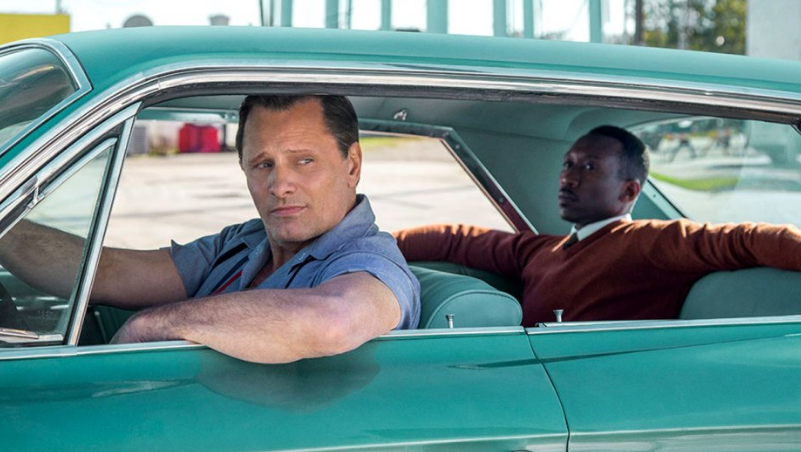
The story of Green Book is simple enough; internationally renowned black pianist Don Shirley (Mahershala Ali) is undertaking a concert throughout the Deep South in 1962 and Tony Vallelonga (Viggo Mortensen) is an Italian American bouncer hired to drive him during his tour who has gained a name for himself as a fella who gets things done and will bullshit if he needs to. It’s understandable why this true story has been adapted to the big screen; road trip movies with unlikely and mismatched characters have always been a fun genre and the racial undertones of the time allow the film to explore some (obviously Oscar baiting) but nonetheless profound and important themes. The initial portrayal of the two men is handled well; Shirley is as refined, well spoken and worldly as Vallelonga is brash, rough and crude. Which in itself is a welcome transgression from the usual portrayal of the down on his luck black character needing the charity of white characters to overcome adversity (The Blind Side, The Intouchables).

The progression of the film is predictable enough, it is evident that the two men won’t initially get along and by the end of the film will have become inseparable. However the way in which the friendship develops throughout the film is so well handled and organic that by the end of the concert tour, the fact that Doc arrives unannounced for Tony’s Christmas dinner brought a happy tear to my eye rather than a cringe. Both performances are excellent throughout, particularly Viggo Mortensen’s portrayal of Vallelonga which is endearing and avoids becoming satirical. The establishment of relationships and friendships don’t come from immediate and blatant discussions of race and poverty, they arise from the smaller moments and the film recognises that. There are some genuinely moving instances regarding Shirley’s presence in the racially divided Deep South, particularly when Tony accuses Shirley of not knowing his own people and Shirley responds by saying that he has been exiled from them too because of what he does and how he lives. “If I’m not black enough and I’m not white enough then what am I Tony?” There is no shortage of the examples of racism Don Shirley faced during his tour, notably being invited as the guest of honour to perform but being refused to eat at the establishment’s restaurant or use the bathroom. You can see the pain and humiliation in Shirley’s eyes, and Ali plays his struggle between anger and dignity with subtlety.

The relationship between the two men is authentic and allows for both moments that are fun to watch and others that are, while predictable, properly touching. Green Book knows that its source material is provocative, and while the plot of the film progresses more or less as you would expect it to, the two leads bring warmth and humanity to what was ultimately a beautiful friendship. And I left the cinema happier having seen it.

By Jock Lehman

The Favourite

I wasn’t sure what to expect with Yorgos Lanthimos’ “The Favourite”. I suspected that it was going to be visually very impressive and that the production crew would have spared no expense to recreate the lavish surroundings of Queen Anne. I knew that it had been nominated for Best Musical or Comedy at this year’s Golden Globes, but I’ve always been a little bit skeptical of period pieces that strive for laughs. I’m an easy laugh in movies, and if The Favourite had gone down the line of stringent historical accuracy with the occasional wry or witty 18th century turn of phrase I probably would have chuckled. What I didn’t expect was to be properly smiling and properly laughing for scene upon scene. Rather than portray the characters with stringent accuracy regarding humour, temperament and language in keeping with the time; screenwriters Deborah Davis and Tony Macnamara have taken the key defining themes of Queen Anne and her counterparts and given them more contemporary dialogue which is genuinely hilarious. I’m fairly certain Queen Anne would never have said “I like her, I like the way her tongue feels when it’s inside me”, but the haughtiness and the famous petulance of the historical figure exudes throughout. There are many moments like this throughout the film, where the audience and I in the cinema were taken by surprise by corseted and royal women who say “cunt” and “fuck” and members of parliament throwing food scraps at a naked man while still donning their white powdered wigs. 

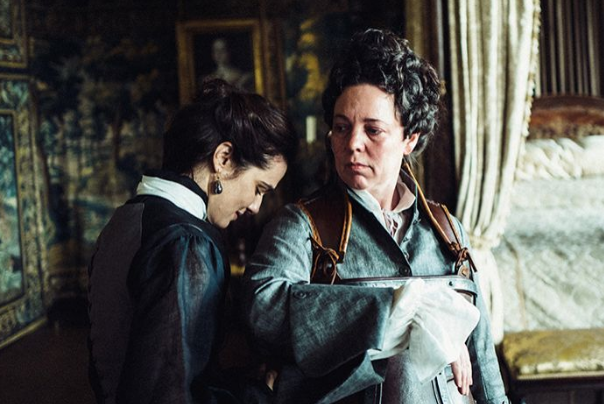
The three central female figures of the film are incredible throughout, but none more so than Olivia Colman. I’ve enjoyed Colman in her roles within such comedic shows as Peep Show and especially so in her more serious turn in Broadchurch, and I’m genuinely excited that she’s starting to appear in Hollywood films. Queen Anne in this film could easily have become a caricature and painfully one noted. In the hands of a lesser actress she would have been shrill, demanding and petulant but without the depth and genuine empathy that Colman has brought to the role. There is a great scene in the film, purely consisting of Queen Anne wandering throughout her palace, bored and sulking, eventually gorging herself on food and vomiting into a silver basin that her servant holds for her because she has nothing else to fill her time. Despite the gross and ridiculous wealth surrounding the woman, you can’t help but feel sorry for her. Seventeen rabbits sit in gilded cages to represent each of the seventeen pregnancies she’s lost and Colman’s incredibly expressive face as she watches Lady Sarah dance while her gout ridden legs keep her bed and wheelchair-ridden exudes her loneliness and jealousy without a single word. As talented a comedic actress as Colman is, her capacity to inject humanity and tragedy into a character that could have been extremely isolating for audiences to identify with is more than enough to warrant her recent Lead Actress nomination. 

As for Weiz and Stone, they embody their characters well. Weiz is austere and commanding while Stone’s wide eyed innocence makes her the perfect canvas for the seemingly naive but calculating Abigail. The film resists the temptation to give one of the women a moral edge over the other; each is despicable and ruthless in their own way but are nonetheless relatable in their pursuit of Anne’s favour in a time where empathy was understandably superseded by the need to endure. Nicholas Hoult holds himself well as the arrogant and pompous leader of the Whigs party, and the other supporting characters do just fine but the focus remains throughout on the three impressive female leads. My English teacher often quoted Mark Twain “Comedy is tragedy plus timing”, and The Favourite has managed to dive in and out of the two with style and ease. It has managed to do the tricky thing; portray individuals in a time completely alien to our own and allowed its audience to, if not identify, at least feel as if they were watching actual people, warts and all, and not simple impressions. Which I suppose is the entire purpose of film in the first place. 

By Jock Lehman